
Amado Water Key For Trumpet
Amado Water Key or Amado Spit Valve For Trumpet

Traditional lever and spring water key for trumpet.
When a person plays a trumpet, the players warm, moist breath will condense within the inside trumpets metal tubing. This condensation is caused by warm water vapor in the players breath which will gradually become cooler as the moist air vapor travels through the cooler metal tubing of the trumpet. In addition to water condensation, saliva or spit from the players mouth will also accumulate within the metal tubing of the trumpet.
As the gaseous moist air vapor becomes cooler, the air vapor converts to liquid H20 or Water which begins to rapidly accumulate within the brass metal tubing of the instrument. As the water and saliva accumulate within the brass metal tubing of the instrument, this liquid can have a noticeable negative impact on the quality of sound that the instrument produces.
Condensation collects at the lowest point in a trumpets tubing. This location is almost always located at the bottom turn of a trumpets main tuning slide. Unless the accumulated water and spit are efficiently extracted from the trumpet, the water buildup will keep increasing until the trumpet players air volume as well as the trumpets natural vibratory sound waves will begin to move the accumulated water which will cause a very pronounced ‘gurgling or bubbling’ sound within the metal tubing of the trumpet.
Before the advent of water keys, trumpet players emptied the condensation either by blowing a very robust volume of air through the trumpet or doing as French Horn players do, pull a slide from the horn quickly, and dump the water on the floor. During a musical performance, this type of awkward movement is not always acceptable to either the performer or the performers audience.
Consequently, brass instruments became fitted at the factory with a simple condensation extractor or ‘Water Key’ which is euphemistically referred to as a ‘Spit Valve’.
To remove the accumulated water or what brass players commonly refer to as ‘spit’, the brass player opens the ‘water key’ or ‘spit valve’.
The water key or spit valve is a small hole in the metal tubing that is kept closed that is placed within the tubing of the brass instrument.
On the trumpet and cornet, usually two small holes are placed at two locations within the metal tubing where water and saliva will tend to accumulate naturally due to gravitational forces.
The performer will simply depress the water key or spit valve with one finger which will open the small hole in the metal tubing which will then allow any accumulated water and saliva to empty from the brass musical instrument in a comparatively unobtrusive manner.
The “traditional” water key or spit valve, is comprised of the following parts:
- A lever
- A Spring
- A round cup at the end of the lever.
- A round seal made of either cork or neoprene to act as a pad set within the cup at the end of the lever.
The padded cup will seal the small hole that enables accumulated water and saliva to drain from the trumpet.
The problem with this type of water key or spit valve design is that it is prone to failure in multiple areas. The cork padding in particular will typically dry out and begin to crack and will need to be replaced within a year or less before these padded seals will begin to leak air from the tubing of the trumpet.
The neoprene padding will last longer than cork, but will eventually need to be replaced as well.
The deterioration in the padded seal will normally be gradual and replacement can be planned for before catastrophic failure might occur during a critical performance effort.
However, sometimes the glue that holds the pads inside the cup at the end of the lever will become so dry that the pad will fall out of the cup. This has happened to the Author of this essay on at least one occasion. An emergency replacement is typically ‘toilet paper’ or ’tissue paper’ or even a handkerchief held in place by the spring supported lever.
Also, the spring that manages the lever movement of water key can fail without warning
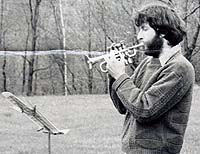
Author, Bob Amato UMASS-Amherst 1967-1972 practicing Selmer 4 piston valve piccolo trumpet outdoors in the fall of 1970 where the Author earned a BA in Trumpet Performance.
due to unpredictable metal failure of the spring itself. The Author of this essay has had this happen to him on multiple occasions over the years early in his career. Consequently, most trumpet players who experience water key valve spring failure will carry heavy rubber bands on their person. A rubber band will be tightly wrapped around the lever which will prevent the padded seal at the base of the lever from opening unless manually activated.
Another significant drawback to the “traditional” water key or spit valve design is that even though the hole used to expel water from the trumpet is small, this ‘gap’ in the tubing can have an adverse impact on the air flow that naturally moves through the trumpet metal tubing. This gap will always create turbulence that can adversely impact the ease and feel of the response of the trumpet, intonation, and other small but observable acoustic factors as well. In fact, some classical orchestral oriented trumpet players will use trumpets without any water keys or spit valves in order to eliminate any undesirable air flow concerns within the body of the trumpet.
Although not a perfect solution to all of these “traditional” water key or spit valve design concerns, in the 1960’s a man named Raymond A. Amado invented the ‘Amado Water Key’ or ‘Amado Spit Valve’ for trumpet. The ‘Amado Water Key’ was first introduced to trumpets by the Getzen Company in the 1960’s. Mr. Amado was awarded United States Patent Number US3625104 in 1971.

Invented by Raymond A. Amato, the Amado water key was first introduced to a trumpet by Getzen in the 1960’s.
The ‘Amado Water Key’ or ‘Amado Spit Valve’ consists of a short hollow cylinder mounted transversely on the trumpets tuning slides. The valve cylinder has a button on one side that operates an enclosed stopper valve that is held closed with a cylindrically shaped spring. A small hole is set to the bottom side of the trumpet slide tubing to drain the water. The trumpet player will press on the button and blow into the trumpet to drain the water.
The Amado design has the advantage that it presents less of a deviation from a smooth inner slide wall metal tube compared to the larger-volume drain port in the traditional lever actuated design.
Including the Author of this essay, countless trumpet players have determined that the Amado Water Key or Amado Spit Valve will improve a trumpets response and intonation.
The following is a copy of the Amado Water Key drawing that Raymond A. Amado submitted to the United States Patent Office in 1970
Amado-Waterkey-Patent-Application-US3625104-drawings-page-1

Essay Author, Bob Amato in New Orleans in 2012 visiting his best and only friend, ‘Wanna Be’ Bandleader, “Square Bear” – a 165 lb. Female Tibetan Mastiff that was 5 years old.