
Julian Olevsky UMASS Violin
Julian Olevsky UMASS-Amherst Music Department Violin 1967-1985
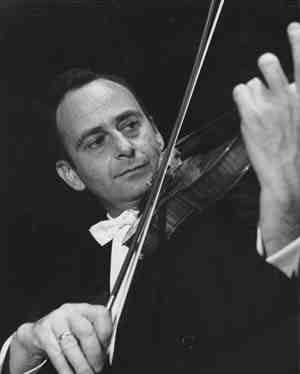
Julian Olevsky at UMASS-Amherst circa 1968.
Julian Olevsky (1926-1985) was born in Berlin to a Polish father who was a professional violinist. Julian’s mother was Russian. Julian Olevsky moved to the United States in 1947.
Julian Olevsky was a child prodigy. At age 10, Julian Olevsky made his recital debut and about two years later – in 1938 – made his debut with orchestra. At the age of 12, with the Orquesta Sinfonica Argentina under Austrian conductor Kurt Pahlen, Julian Olevsky played the Glazunov concerto.
In 1949, Julian Olevsky made his New York debut at Town Hall. Julian’s appearance at Town Hall was highly successful and much-praised.
In 1950, Julian Olevsky played his first recital at Carnegie Hall. Julian also played an additional three more recitals at Carnegie Hall over the course of his career. Julian went on to play in most of the great concert halls around the world and with many of the great orchestras and conductors.
Music critics frequently compared Julian Olevsky to Jascha Heifetz and David Oistrakh.
Julian Olevsky served as Professor of Violin at the University of Massachusetts-Amherst from 1967-1985
The Author of this essay was an instrumental performance
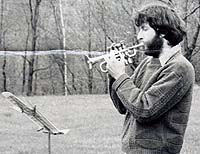
Essay Author, Bob Amato UMASS-Amherst 1967-1972 practicing Selmer 4 piston valve piccolo trumpet outdoors in the fall of 1970.
major as well as instrumental music education major between 1967 and 1972.
As an instrumental music education major, Applied educational courses that revolved around the violin was a core music education requirement.
The Author of this essay had the good fortune of having Julian Olevsky as the instructor of applied music education oriented violin around 1970.
While performing research on this essay in late 2018, the Author was shocked and deeply saddened to learn that Julian Olevsky had passed away in 1985.
Julian Olevsky and his beautiful as well as gifted pianist wife, Estela Kersenbaum Olevsky were the UMASS equivalent of Hollywood Royalty – (Think Frank Sinatra and Ava Gardner or Liz Taylor and Richard Burton without vices, naughty behavior, and bad manners.)
Julian was always well groomed and a dapper dresser who could have made the cover of GQ Magazine on a monthly basis. Julian also had a marvelous droll sense of humor as well and was always a pleasure to be around.
Julian Olevsky Virtuoso Concert Solo Violinist At UMASS
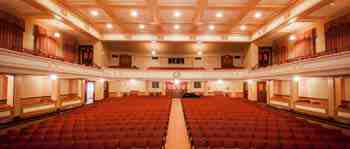
Bowker Auditorium UMASS-Amherst.
Julian Olevsky’s abilities as a classical, concert hall solo violinist were remarkable. Julian Olevsky produced a gorgeous vibrant tone, exquisite musical phrasing, and flawless technical skills. Julian’s tone on the violin was so vibrant that it would project to every corner of the 700 seat Bowker Auditorium at UMASS-Amherst regardless of the volume level that Julian Olevsky produced. When performing as a solo violinist, Julian always wore a perfectly tailored tux and tails that complimented his slim physique and perfect violin performing posture. Not only did Julian Olevsky play the violin with a masterful virtuoso skill that was extraordinary, Julian looked and carried himself like a virtuoso violinist from an era long gone by. Julian Olevsky’s charismatic performing demeanor during solo concert hall violin performances was mesmerizing.
The Author of this essay made it a point to attend all of Julian Olevsky’s solo music faculty
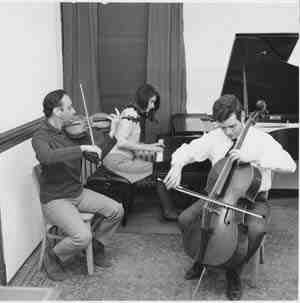
Julian Olevsky rehearsing with the UMASS Faculty Trio with Joel Krosnick on Cello and Estela Olevsky on Piano on September 12th, 1968.
recitals as well as joint recital performances with other UMASS-Amherst Music Faculty Members. Julian Olevsky’s other faculty recital performances including his accompanist wife, Estela Kersenbaum Olevsky on piano. Julian Olevsky also performed marvelously with the Faculty Trio which included his wife, Estela Kersenbaum Olevsky on piano, Julian Olevsky on Violin and Joel Krosnick on Cello. The UMASS-Amherst Faculty Trio performances were particularly outstanding.
The Author of this essay became friendly with Julian Olevsky in the late 1960’s. This Author’s mother spoke fluent Polish and Julian’s father from Julian’s younger days back in Berlin was also Polish. In the late 1960’s, the Author accompanied both of his parents to a Julian Olevsky faculty recital and after the recital, this Author introduced Julian Olevsky to the Author’s Mother who immediately began conversing with Julian in Polish. Julian was quite impressed by the Author’s Mother’s fluency with the Polish language and her knowledge regarding the Polish culture.
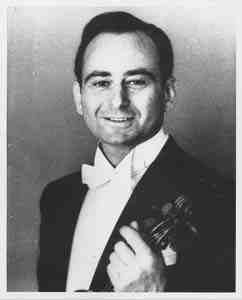
Julian Olevsky at UMASS-Amherst circa 1967.
This Author’s mother became smitten with Julian after meeting and conversing with Julian in Polish after this performance. This Author’s mother told her husband and this Author that Julian was the most handsome man that this Author’s mother had ever met.
Additionally, both Julian Olevsky and his wife, Estela attended most if not all of the Author’s student trumpet recitals as well as brass ensemble student performances as well.
The Author’s parents would attend many of the Author’s student performances and if Julian Olevsky was in attendance, the Author’s Mother and Julian would inevitably converse at length in Polish after the Author’s student performances. These conversations were always interspersed with laughter with this Author’s mother responding to Julian’s sense of humor.
Also, around 1970, the Author of this essay was enrolled in an applied violin educational course that Julian Olevsky taught. Julian taught applied violin to the beginners in this class with great skill coupled with much patience. Even the uncoordinated Author of this essay achieved enough skill in Julian’s applied violin course to be awarded an ‘A’.
And, either before or after many of these applied violin education classes it was not unusual for Julian Olevsky to as this Author when the Author’s Mother would be visiting UMASS again.
Both Julian Olevsky and his wife, Estela developed a fondness for this Author. On at least two occasions in the early 1970’s, this Author was invited to the Olevsky family home for dinner. And, Julian’s wife, Estela was every bit as fine as a cook as she was a concert pianist.
Professor Olevsky and her Husband, Julian made the Author completely at ease and the Author really enjoyed these gatherings.
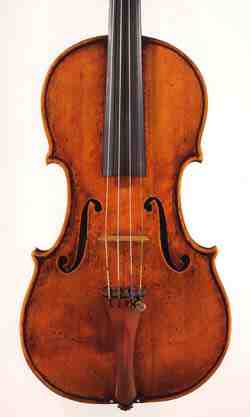
Guaneri ‘-‘del Gesù’-Violin- 1741
After dinner, Julian Olevsky would show the Author Julian’s priceless violin collection. This violin collection included Julian’s personal favorite, the Emperor Guarnerius Del Gesu Violin from 1738, also see.. Wiki one of the better-known Guarnerius violins. That violin had been owned by one of Napoleon’s Military Assistants and that’s supposedly how it acquired its name, Joseph Guarnerius del Gesu. This Author did some research on violin maker, Bartolomeo Giuseppe Antonio Guarneri, del Gesù. Violin’s of a pedigree similar to Julian Olevsky’s Emperor Guarnerius Del Gesu from 1738 have sold from $10Million to $18Million between 2010 and 2018.
Julian Olevsky also showed the Author three other Violins that were also priceless. These violins included an Amati and two Stradivarius violins. The Author of this essay has often wondered over the past 50 years if Julian Olevsky was only joking regarding the ownership of the Amati and two Stradivarius violins. However, this Author is convinced that Julian’s ownership of the Amati was not a joke. And, it is quite probable that the ownership of the two Strads was not a joke either.
After each dinner engagement at the Olevsky family home, Julian would not just only show
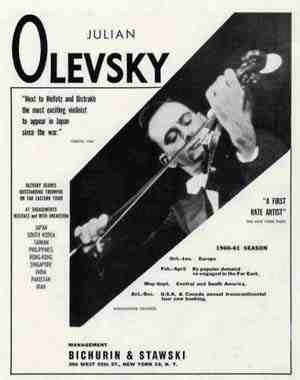
Julian Olevsky Marketing Flyer circa 1962.
this Author the entire extraordinary violin collection, Julian would insist that this Author handle and carefully inspect each of these priceless instruments with this Author’s ‘bare’ hands. No acid free white gloves were used in handling these violins.
Even more astounding to this Author was Julian’s insistence that this Author actually try to play these violins. Julian would hand this Author a bow manufactured in antiquity that had to be worth 50 times more than either a professional grade Schilke or Bach Stradivarius trumpet and insist that this Author ‘make music’.
This Author would protest and express great fear that this Author would damage these priceless violins. In spite of the Author’s fearful protests, Julian would insist that this Author try and ‘make music’. And, the only training that this Author ever had on violin was from Julian’s class on rudimentary applied educational oriented violin performance training. These very sorry, and worse than pathetic ‘make music’ efforts performed on Julian Olevsky’s priceless violin collection always led to a ‘mini’ private lesson that the grand master violin virtuoso, Julian Olevsky provided to this Author with much good natured humor.
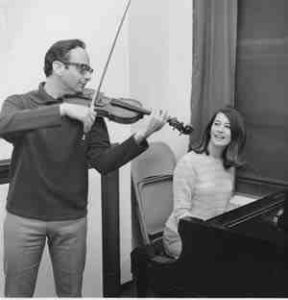
Julian Olevsky rehearsing with his Wife, Estela at UMASS–Amherst circa 1968.
After the embarrassingly failed efforts to ‘make music’ on Julian Olevsky’s priceless violin collection, this Author would then be treated to an approximate two hour private recital rehearsal performed by Julian on Violin and Estela on Piano. The chemistry that this pair had between them both personally and professionally was remarkable. The Author of this essay will always cherish the memories of these astounding private rehearsals at the Olevsky family home in Amherst, Massachusetts.
Julian Olevsky was an enormous asset to the UMASS-Amherst Music Faculty and UMASS in general was most fortunate to have Professor Olevsky as a faculty member from 1967-1985.
The Author of this essay will always remember his musical encounters with Julian Olevsky as one of the highlights of this Author’s music education at UMASS-Amherst from 1967-1972.
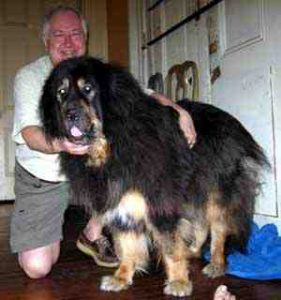
Essay Author, Bob Amato in New Orleans in 2012 visiting his best and only friend, ‘Wanna Be’ Bandleader, “Square Bear” – a 165 lb. Female Tibetan Mastiff that was 5 years old.
</div