
Larry Weed UMASS Trombone Concert Band Conductor
Larry Weed UMASS-Amherst Music Department Trombone and Concert Band Conductor 1967-1972
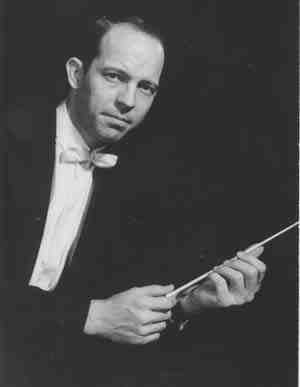
Larry Weed at UMASS-Amherst circa 1978
Larry Van Weed (1936-2008) was born in Oklahoma City, Oklahoma.
Larry Weed was awarded a Bachelor’s Degree in Applied Music from Oklahoma City University and a Master’s Degree in Music Education from Eastman School of Music in Rochester, New York. Larry performed with the Oklahoma City Symphony, the Eastman Philharmonia, the Scranton Philharmonic, the Lubbock Symphony, the Syracuse Symphony and the American Wind Symphony.
Professor Larry Weed became a member of the UMASS-Amherst Music Department where he was the Assistant Director of Bands and trombone/low brass instructor from 1966-1972. At UMASS-Amherst the Assistant Director of Bands conducted the Concert Band which primarily served non-music majors, or music majors who did not do well enough on their audition to be admitted to the Symphony Band under the Director of Bands, Professor John Jenkins. Professor Weed was also responsible for assisting Professor John Jenkins in staging and rehearsing the UMASS-Amherst Minute Man Marching Band during the fall football season. Professor Weed was also a member of the UMASS-Amherst Faculty Brass Trio.
Beginning in 1972, Professor Larry Weed was one of the founders of the International Trombone Association (ITA) became the first Editor of the newly established ITA Journal. Professor Weed served as the ITA Journal editor to at least 1982 and possibly as late as 2002. See International Trombone Association Journal Vol. 30, No. 4, October 2002.
The Author of this essay, was an instrumental performance major as well as an instrumental music education major at UMASS-Amherst from 1967-1972.
As an instrumental music education major, applied educational courses that revolved
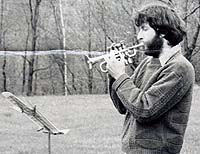
Essay Author, Bob Amato UMASS-Amherst 1967-1972 practicing Selmer 4 piston valve piccolo trumpet outdoors in the fall of 1970.
around the trombone, baritone horn/euphonium, and tuba were required courses.
The Author of this essay had the good fortune of having Professor Larry Weed as the instructor for applied trombone, baritone horn/euphonium, and tuba that was provided for these required educational courses.
Professor Weed’s teaching methodology was designed to teach beginners the basic rudiments of trombone, baritone horn/euphonium, and tuba were outstanding courses. Professor Weed had a marvelous understanding of pedagogy that was suitable for all low brass skill levels. And, Professor Weed had a remarkable understanding of the physical requirements to develop embouchure and breath control on all brass instruments which included trumpet and french horn in addition to all low brass musical instruments. During one of these courses, one of the methods that Professor Weed brought up and discussed was the Pivot System for Trumpet and Trombone as taught by Dr. Donald S. Reinhardt in Philadelphia, Pennsylvania. Interestingly, a fine, non-music major trumpet player, John Perko who played 1st cornet, 3rd chair with this Author in the UMASS Symphony Band studied trumpet with Reinhardt after leaving UMASS in the Spring of 1972. Professor Weed’s personal library contained many scores of cornet/trumpet, trombone, and tuba pedagogical approaches to developing skills on these methods. And, Professor Weed was also intimately familiar with how these pedagogical methods should be applied.
This Author lived with John Perko at John’s apartment located in Fitchburg, Massachusetts for a few months beginning in late 1977 after this Author completed a tour playing lead trumpet with the Ringling Bros. and Barnum and Bailey Circus. John Perko’s trumpet playing abilities improved dramatically by that time. John Perko could slowly and effortlessly perform glissando’s on the trumpet without the benefit of valve usage into the extreme high register quite with a very resonant tone as well. This was the only time this Author has ever heard a trumpet player play this type of exercise in this manner. The embouchure control that John Perko had developed by way of studying with Dr. Donald S. Reinhardt was remarkable. This Author ended up taking upwards to seven trumpet lessons with Dr. Reinhardt in early 1978.
Under Professor Weed’s direction, this Author played first trumpet in the UMASS-Concert band from 1967-1969 in addition to performing on cornet with the UMASS Symphony Band under the Direction of Professor John Jenkins. Under the joint direction of Professor Weed and Professor Jenkins this Author also performed with the UMASS Minuteman Marching Band from 1967-1970.
This Author was awarded an ‘A’ grade on all UMASS-Amherst music courses that were associated with Professor Larry Weed.
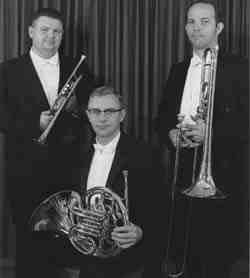
UMASS-Amherst Instructor with Music Department Brass Trio Members: Professor Walter Chesnut Trumpet, John Jenkins on French Horn and Larry Weed on Trombone circa 1968.
On a personal note, the Author of this essay would like to add that Professor Weed had some interesting eccentricities as follows:
- Professor consumed massive quantities of Coca-Cola in glass bottles only. There was a Coke machine in the Old Chapel Music Building where Professor Weed’s office/teaching studio was located. Professor Weed must have pumped a roll of dimes into the Coke machine on a daily basis. And, this Author noted that Professor Weed primarily subsisted on sandwiches and snack food.
- Professor Weed purchased large numbers of orchestral scores for his personal collection. Professor Weed’s collection of orchestral scores was considerably larger than the UMASS-Amherst
Music Library between 1967-1972. And, if a student was looking to study an orchestral score that was not on file at the UMASS-Amherst music library, Professor Weed was always approachable. If Professor Weed, had the score a student was looking for, he would always be happy to loan it to a student.
- Professor Weed purchased each and every Deutsche Grammophon Classical LP Vinyl Record immediately upon release for his personal collection.
On one occasion, this Author had the opportunity to visit Professor Weed’s home. Sometime in the spring of 1971, this Author was wrapping up a practice session in a practice room located in the basement of the Old Chapel after 9PM. Professor Weed was a
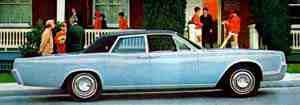
1967 Lincoln Sedan similar to Larry Weed’s own vehicle in the late 1960’s
bachelor at that time, and tended to stay in his office rather late on week nights which was located on the top floor level of the Old Chapel. This Author encountered Professor Weed leaving the Old Chapel and Professor Weed was carrying a box of papers. Professor Weed’s office studio tended to get rather cluttered and he had boxed quite a bit of papers up and was going to bring it to his home. Professor Weed had a big Lincoln Town Car which would
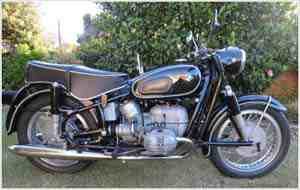
Essay Author, Bob Amato’s 1960 BMW R60 purchased in the Spring of 1966 for $425.00
hold a ‘lot of stuff’ and the vehicle was driven on the sidewalk to the front door of the Old Chapel. This Author offered to help load the numerous packed boxes into Professor Weed’s vehicle. And, this Author ended up traveling with Mr. Weed to help him carry the boxes from his vehicle to his home. This Author had a motorcycle at that time that was parked near the Old Chapel and Professor Weed drove this Author to the motorcycle and this Author followed Professor Weed to his home.
The moment this Author walked into Professor Weed’s home, this Author was offered a ‘Coke’ by Professor Weed. Professor Weed’s home was filled with scores and vinyl LP recordings.
A large number of the LP recordings were still wrapped in plastic and never played. Professor Weed enjoyed jazz and had a great vinyl record collection that was mostly 1950’s era Big Band and small group Be-Bop. Big Band recordings were mostly Stan Kenton and Woody Herman with some Maynard Ferguson late 50’s to early 60’s recordings. Professor Weed was a fan of jazz trombonists, Urbie Green, J.J. Johnson, Slide Hampton, Carl Fontana, Kai Winding, and Frank Rosolino.
Shortly after this Author entered Professor Weed’s home, Professor Weed put on his vinyl recording of Tutti’s Trombones which was released in the mid-1960’s. And, then Professor Weed put on a series of ‘Trombone For Two’ recordings that originated from the 1950’s that featured J.J. Johnson and Kai Winding playing together. This Author and Professor Weed also listened to some vintage Urbie Green, Carl Fontana, Frank Rosolino and Slide Hampton jazz combo solo trombone recordings. This Author got the impression that Professor Weed had very few visitors to his home and Professor Weed seemed to really enjoy sharing his Jazz Trombone recording collection with someone who could appreciate it. This Author must have stayed up till at least 3 AM listening to Jazz Trombone recordings with Professor Weed.
Professor Weed was an excellent conductor. However, Professor Weed utilized an exaggerated amount of body and arm movement that must have provided a significant amount of calisthenic exercise over the course of a two hour rehearsal. Also, during rehearsals only, Professor Weed also sang LA-LA-LA style loudly along with the bands he conducted. This Author never heard any other conductor do this before or after Professor Weed’s conducting practices.
On a Monday through Thursday basis, this Author would try to practice trumpet for 3 to 4
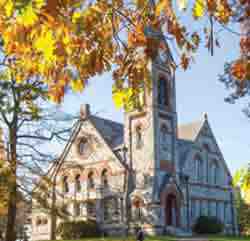
The beautiful Old Chapel was the epicenter of all UMASS Music Department student instrumental music activities from 1967-1972. The author spent many hours daily – 7 days a week either rehearsing or practicing within this fine building.
hours a day that were split into 2 and often 3 separate practice sessions. The final practice session would be frequently performed in a practice room in the basement of the Old Chapel. Between 1967 and 1972, the Old Chapel practice and rehearsal facilities were available for students 24 hours a day and seven days a week. The UMASS Symphony Orchestra rehearsed two evenings during the week and these rehearsals ended around 9PM. Consequently, this Author would frequently practice in the Old Chapel until midnight and sometimes longer.
After practicing trumpet late at night at the Old Chapel, this Author would occasionally go upstairs to the main rehearsal hall which was right around the corner from Professor Weed’s office/studio.
On many occasions Professor Weed would be sitting behind his desk in his rather cluttered office space. Professor Weed would always have the door of his office open if he was not teaching a trombone lesson. And, before this Author would say Hello to Professor Weed this Author would often see Professor Weed stareing off into space with a profound sad look on his face. It was a look of someone who wishes they were somewhere else, but did not not where to go.
Professor Weed would go out of his way to provide interesting and useful information to music students that he thought showed promise. In the late 1960’s, Professor Weed gave to this Author several printed pages of ‘breathing exercises’ whose development was attributed to Arnold Jacobs who was the famous Tuba Player with the Chicago Symphony from 1944-1988.
On another occasion, Professor Weed heard this Author practicing Herbert L. Clarke’s famous cornet solo composition, ‘Sounds From The Hudson’ late one night at the Old Chapel. A few days later, Professor Weed lent to this Author his own Autographed copy of ‘Glenn D. Bridges’ Pioneers in Brass. Pioneers in Brass is one of the few books on brass players of the 19th and early 20th Centuries, written in third person by the author, himself a circus trombonist who was there and heard and met many of those he writes about.
This Author had the privilege of meeting with Glenn D. Bridges on two occasions in the late 1970’s at Mr. Bridges winter home in Daytona Beach, Florida shortly before Mr. Bridges passed away. Mr. Bridges gifted to this Author, two autographed 1965 first editions of ‘Pioneers in Brass’ and also gave to this Author two reel to reel tapes that contained early brass players playing amazing solo’s that were originally recorded on cylinders and early wax platters.
Professor Weed attended all or most all of this Author’s numerous student trumpet recitals as well as brass ensemble performances. Professor Weed also performed on bass trombone on the fifth selection of this Author’s senior graduation trumpet recital. The closing number on this recital was Gabrieli’s Canzon Duo Decimi Toni a 10 arranged for a 10 piece brass ensemble (double antiphonal brass quintet).
In late May of 1972, near the end of the Spring, graduation semester, this Author going to the Old Chapel to practice trumpet and this Author encountered Professor Weed carrying many boxes of ‘stuff’ to his Lincoln Continental which was hooked up to a good sized U-Haul moving trailer parked by the Old Chapel front door. Professor Weed was being assisted with a blond co-ed vocal music education who was a classmate [’72] of this Author. Professor Weed told this Author that the couple had either recently had gotten married or were about to get married. This romance was apparently kept secret from all but themselves. Professor Weed told this Author that he was leaving UMASS-Amherst to teach at a school in Mississippi.
While doing research on this essay, this Author confirmed that Professor Weed was a member of the Music Faculty at the University of Southern Mississippi from the fall of 1972 through the Spring of 1977. During this time frame, Professor Weed was a member of the Southern Arts Brass Quintet, Director of the Collegium Musicum and Trombone Choir, and was the principal trombone with both the Jackson and Meridian Mississippi Symphony Orchestras.
After departing the University of Southern Mississippi at the conclusion of the Spring 1977 semester, it looks like Professor Larry Weed enrolled in the Fall of 1977 at the University of Michigan at Ann Arbor with the intention of obtaining a Doctor of Musical Arts Degree (DMA). Larry Weed performed on December 12, 1977 with a wind ensemble at the University of Michigan School of Music.
According to this University of Michigan School of Music Coming Events notice, Larry Weed performed the following two recitals to complete his DMA:
June 27, 1979 Trombone Recital – Larry Weed, DMA: Recital Hall, 8PM
and
July 8, 1979 Trombone Recital – Larry Weed, DMA: Recital Hall, 4PM
And, this now Dr. Larry Weed saga becomes somewhat more interesting at least to this Author.
In the late Fall of 1981, this Author completed a 4 1/2 month tour as Band Leader/Lead Trumpet with Circus Tivoli in Canada followed by a seven week tour as Band Leader/Lead Trumpet with Ward Hall’s International World of Magic. This Author then returned to his temporary residence in Kissimmee, Florida which was quite close to Disney World Resort.
 Disney World employee’s more full time commercial musicians than any other location in the country with the exception of Disney Land in Anaheim, California. And, these commercial musical opportunities at Disney are negotiated through a Musicians Union Contract that provides a clearly defined compensation package which also includes medical and vacation benefits. Disney also pays considerably more than other full time commercial playing opportunities in the United States. Consequently, working as a commercial musician at one of the Disney Theme Parks is a sought after position for those so inclined. Almost all full time Disney Theme Park commercial musicians work a five day work week with two days off. Plus there is additional time off for personal days, U.S. National Holidays, and at least two weeks paid vacation every year. Because the Disney Theme Parks are open seven days a week from around 8AM to 11PM, ‘substitute, part time’ musicians are required in sizeable numbers. And, a part time musician can be elevated to ‘full time’ if a ‘full time’ Disney Theme Park musician departs.
Not long after this Author returned to Kissimmee, Florida in the late fall of 1981, Disney World announced a ‘Cattle Call’ open ‘Brass Player’ audition for musicians seeking part time employment. The audition was scheduled for 9AM to 5PM during a week day with no appointment needed.
This Author had a full time gig lined up in six weeks New Orleans at the world famous ‘Blue Room’ at the Fairmont Hotel, but thought it might be good to make some extra money before relocating to New Orleans in November 2001. This Author showed up for the Disney World brass player open audition around 2PM.
When the Author arrived, there were easily well over 200 trumpet, trombone, and tuba players standing around in a large room waiting for their names to be called.
Shortly after this Author arrived, he heard his name being called out loudly:
“Hey Bob – Bob Amato – Hey Bob-Bob Amato – Hey Bob – Hey Bob, it’s Larry Weed” and so forth.
Lo and Behold, the person calling this Author’s name was Larry Weed. This Author was in a state of shock. Larry Weed had a huge smile on his face, and was the only person in the room that this Author recognized. And, this Author was clean shaved since early 1978. From 1968-1972, this Author wore a heavy bushy beard. How Larry Weed recognized this Author still makes this Author wonder.
This Author’s exchange with Larry Weed was brief as follows:
Bob: “Larry, what are you doing here?”
Larry: “Great to see you, What are you doing here?”
Bob: “Larry, I asked you first.”
Larry: “No – Tell me what you have been up to.”
Bob: “I have been working as a band leader and/or lead trumpet player for the past seven years with four different circuses including 4 years with Ringling Brothers and Barnum and Bailey.”
This really caught Larry’s interest for some reason and he asked this Author a number of questions. Right after this Author finally asked Larry one question which was “How Long Have You Been Waiting”?
Larry: “Almost five hours!”
Right then, Larry Weed’s name was called out for an audition and that was the last time that this Author has ever had with Dr. Larry Weed. This Author left the open brass player audition at this time not wanting to wait ‘forever’ for the possibility of obtaining some part time work that would only last for a maximum of six weeks.
This Author often wondered over the past 38 years why a person with academic credentials that included a DMA from the University of Michigan at Ann Arbor would want to even consider an a musical opportunity to perform ‘bad music, that is badly arranged’ to entertain completely ‘mindless’ theme park visitors on a part time basis in particular.
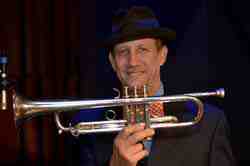
Kevin Clark, Bandleader Dukes of Dixieland in New Orleans circa 2010.
In 1989, this Author was living in the New Orleans French Quarter and while walking around, this Author bumped into a former trumpet player colleague named Kevin Clark.
This Author met the then young Kevin right after he got out of a Music School at a College near his home area which was Orlando, Florida. From 1978-1981, this Author played lead trumpet with the 13 piece big show band, at Ringling Brothers & Barnum & Bailey Circus World Theme Park located in Haines City, Florida. The four full time trumpet players worked a five day a week playing schedule. Kevin was hired as a ‘part time’ trumpet player to cover the 2nd and 3rd trumpet part books on the full time, staff musicians days off.
In 1986, the Circus World Theme Park closed for good and Kevin Clark became a full time staff musician at nearby Disney World. Additionaly, Kevin was also a musicians contractor
on behalf of Disney World. Kevin was responsible for ‘contracting’ outside musicians needed to support ‘special musical events’ and performances that routinely contracted to perform at Disney World.
Anyway, by 1989, Kevin Clark had developed considerable skiils as a Dixieland Jazz Trumpet Player and Kevin accepted a full time position playing trumpet with the Dukes of Dixieland https://www.dukesofdixieland.com/ in New Orleans in 1989.
Kevin has worked with the Dukes off and on since 1989 and became the Dukes of Dixieland Band Leader in 2010.
When this Author met Kevin in 1989 in the French Quarter, this Author asked Kevin if he ever had any contact with a trombone player named Larry Weed. Kevin said that he indeed knew and worked with Larry Weed.
Kevin Clark told this Author that Larry Weed that Professor Weed suffered from Alopecia universalis (AU) which is a condition characterized by the complete loss of hair on the scalp and body. Kevin Clark told this Author that Larry Weed had no hair on his scalp nor eye brows when Kevin was associated with Larry Weed by way of musical performances that were associated with Disney World. Kevin also told this Author that Lary Weed acted ‘weird’ which was amplified by Professor Weed’s unusual appearance. Kevin also indicated that Professor Weed was ‘quite the character’ to work around with no further explanation given.
When this Author met and spoke to Larry Weed for 5 to 10 minutes at a performance audition ‘cattle call’ for brass players at Disney World in Kissimmee, Florida in the Fall of 1981, Larry Weed’s appearance was quite similar to what is shown on the late 1960’s dated photograph on this page. Larry’s receding hairline may have receded a bit further since the Spring of 1972 which was the last time this Author had seen and spoke to Larry Weed. There was no evidence that Larry Weed had developed Alopecia universalis or ‘weirdness’ whatsoever that Kevin Clark had described to this Author in the Fall of 1981.
While performing research for this essay in February 2018, this Author learned that Larry Weed had assumed a teaching position at Valencia Community College which is located in Central Florida in the community of Orlando, Florida.
According to a Google Search, it appears that Dr. Larry Weed was associated with the Music Department of Valencia Community College in the Fall of 1979 and maintained that position to at least the year 2000. A Google Search also indicates that Dr. Larry Weed performed as a trombone recitalist on a regular basis from 1979 through most of the 1980’s in the Central Florida area. These performances typically featured Trombone solo literature of a contemporary, avant-garde nature. This Author recalls Dr. Weed performing solo trombone literature of this nature back in the late 1960’s at UMASS-Amherst Music Faculty solo recitals.
Additionally, in 1997 Dr. Larry Weed received a NISOD Excellence in Teaching Award in 1997 in the teaching of Instrumental Music. National Institute for Staff and Organizational Development (NISOD) Excellence Awards who are considered to be innovators in teaching and learning.
And, Professor Weed did not demonstrate any hint of ‘weird’ Kevin behavior or ‘Alzheimer’ like neurological problems or strange behavior that two Professor Weed’s students
at Valencia Community College commented upon at:
http://www.ratemyprofessors.com/ShowRatings.jsp?tid=66226
SEE – MUS101 Post dated 05/07/2011:
“I just wanted to clarify that Dr. Weed had undiagnosed Alzheimer’s Disease during the past 5 or so years he taught at Valencia. He died in May 2008. Please remember that his “weirdness” was due to his horrific illness. He was a musical genius.”
Dr. Larry Weed enriched this Author’s college career at UMASS-Amherst and made him a better musician. This Author will always remember Dr. Larry Weed fondly and hope he is in a better place now.
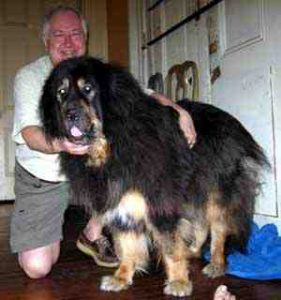
Essay Author, Bob Amato in New Orleans in 2012 visiting his best and only friend, ‘Wanna Be’ Bandleader, “Square Bear” – a 165 lb. Female Tibetan Mastiff that was 5 years old.