
Carmine Caruso Trumpet Instructor
Trumpet Lessons With Carmine Caruso From 1967-1971
 My four year trumpet lesson
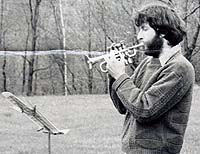
Essay Author, Bob Amato UMASS-Amherst 1967-1972 practicing Selmer 4 piston valve piccolo trumpet outdoors in the fall of 1970.
relationship with the famous New York City based teacher (Guru), Carmine Caruso began when I was 17 years old and a first semester, Freshmen Music Major at UMASS – Amherst in late October, 1967.
In the Fall of 1967, I was performing a weekend night show gig with the “Forever Fabulous Incorporated Soul” 12 member show band and review at a concert in the Boston area.

1968 Publicity Photo of “The Forever Fabulous Incorporated Soul Band and Review” that featured 12 Musicians. A six man horn line, 3 Rhythm, a Front Man soul singer and two backup soul singers who also danced on stage.
The “Forever Fabulous Incorporated Soul” band shared the concert billing with a terrific Boston based R&B outfit called “Sparrow” that had developed a significant following all over New England and Northern New York State. “Sparrow” had 11 performing male members that consisted of 2 Trumpets, Trombone, Tenor and Bari Sax, Guitar, Bass, Hammond B-3 Organ, a top drawer ‘Front man’ blind blues singer that wore a white suit and white hat, and a fine blues harp (harmonica) player who also was an excellent ‘Front man’ blues singer in how own right. “Sparrow” was an exciting band, super tight and a real pleasure to listen to. “Sparrow” played original arrangements that were quite reminiscent of the style of play that made the “Tower of Power Band” out of San Francisco, California so successful. The instrumental sound of the “Swallow” blues band was also similar to Ten Wheel Drive, Electric Flag, Buddy Miles Band, The Ides of March Band, Light House Band, Cold Blood Band, Ambergris, and the Paul Butterfield Blues Band all of which by the late 1960’s and early 1970’s had developed a National reputation in the United States gained through well produced and promoted LP vinyl recordings.
The concert was staged in a large dance hall that had over sized staging setup at opposing ends of the dance floor that could accommodate each of the two unusually large bands for that era.
After the Fall of 1967 joint Soul Band and Blues Band concert in the Boston area I became friendly with both of the excellent “Sparrow” trumpet players who were both attending Berklee School of Music in Boston on a part time basis. I learned that both of these trumpet players took private lessons with “Carmine Caruso” in New York City once a week. Both trumpet players would travel by train from Boston to NYC together on a weekly basis for trumpet lessons with Carmine. Both “Sparrow” trumpet players were super enthusiastic about the “Caruso Method” of brass pedagogy. And, both “Sparrow” trumpet players told me that if I wanted to build some ‘’SERIOUS CHOPS” that I should begin taking trumpet lessons with Carmine Caruso as soon as possible. I obtained Carmine Caruso’s contact information from the trumpet players who performed with the “Sparrow” band.
About two weeks later, I began taking trumpet lessons with Carmine Caruso.

1960 BMW R60/2 motorcycle that this Author purchased when he was a Junior in High School at the age of 16 for $300 with his earnings from performing with the Three Knights Dance Band.
I always traveled to New York to take lessons with Carmine on my pride and joy, a beautifully maintained 1960 BMW R60/2 motorcycle that I drove to NYC even in the rain when I wore a rain suit. The only time when I did not travel to NYC by motorcycle, was in the early winter months of 1967 and into January and February of 1968 when I would travel to NYC via either Trailways or Greyhound Bus because of snow conditions that made travel by motorcycle unwise.
By motorcycle, I would simply place my trumpet case on top of the rear passenger seat and strap it down with a pair of bungee cords. Sadly, the bike was destroyed in August 1971 when I was involved in a head on crash with a Volkswagen Beetle while driving early in the morning in pea soup fog in a small town located near Amherst, Massachusetts. The wreck knocked me unconscious, split my helmet in two, caused a concussion and resulted in me experiencing the quintessential ‘Near Death’ out of body experience.

Carmine Caruso around 1970 sporting a beard.
Between April and November (Thanksgiving) which is when it was not likely to snow, I traveled to NYC via motorcycle to study with Carmine. During the UMASS school year warmer months, and depending when UMASS scheduling would allow, I would travel to have trumpet lessons with Carmine once and sometimes two times a month (typically on a Saturday) and more frequently during the Summer months…typically 2-3 times a month.
Over a 50 year period, Carmine Caruso provided countless hundreds of brass players, the majority were trumpet players in particular, but also many woodwind players as well with extraordinary well-crafted lessons.
However, the lessons DID NOT focus on ‘musicality’ or ‘musicianship’ per se. The focus of the Caruso exercises was resolving the physical challenges of playing a brass instrument.  Playing a trumpet successfully revolves around controlling over 200 muscles in the body as well as breath control. Carmine Caruso always told me as well as all of his students, that the physical mastery of playing the trumpet would make the act of “PRODUCING MUSIC” a far easier task.
I took semi-regular private lessons beginning in 1967 to 1971 at Carmine Caruso’s small studio which was located around Sixth Avenue near 45th or 47th Streets in midtown Manhattan. The Caruso lesson studio was located in an office building that was a short distance on foot from 42nd Street at Times Square. Over an approximate 4 year period, I had at least 80 to 90 trumpet lessons with Carmine Caruso. During that period, the cost per lesson was at least $10.00, probably $15.00, and possibly as much as $20.00.
The Carmine Caruso mid-town Manhattan lesson studio was small. Perhaps 10 X 10 or 12 X 12 feet square with a ceiling that must have been at least 12 feet tall. The studio was a bit unkempt and probably never received the attention of a professional office building housekeeper. There were some shelves with various types of instrumental training literature that mostly revolved around the trumpet. There might have been a small table that had a lamp set on top.
There was a floor lamp in the corner. The primary sources of light were provided by way of an overhead incandescent light bulb set behind a large old-fashioned cream colored mushroom shaped fixture as well as from the single large ‘double-hung’ window opening that was always kept open year round regardless of weather conditions.
There were two straight back chairs that opposed each other at a 45 degree angle. One of the chairs was for the student and the other for Carmine. There was a music stand placed in front of the students chair. There were also one or two additional chairs set near the entrance to the Caruso lesson studio. There was also a coat rack in the corner by the lesson studio entrance doorway. Carmine would hang his rather battered off white over coat on the rack in the colder months of the year.
The Caruso lesson studio was not served by a waiting room nor a secretary-receptionist to handle lesson scheduling. Carmine Caruso always answered the phone and handled his own scheduling. If there was another student in the lesson room with Caruso when the next scheduled arrived, the next student would knock on the door, enter and sit and listen until the current student’s lesson was concluded.
Sitting in the room listening to another Carmine Caruso student perform the same trumpet exercises that I would be performing in a little while became on occasion a rather humbling.experience. In particular, I remember one young student who was about 3 years younger than me. Carmine told me in the fall of 1967, that this particular male student was 3 months shy of his 15th period. The boy was 14 years old. Three years younger than me who was going to turn 18 in December which was a couple of months away. An exercise that this young man performed was one of the same early exercises that Carmine provided to me at his first lesson with Carmine. However, this 14 year old boy continued playing the exercise higher and higher to at least more than an octave higher than I could play this same exercise. This 14 year old boy finally ran out of gas when playing well above a DOUBLE HI C. This was the first time that I had ever heard a trumpet player in person play the trumpet at this extreme upper register. And, the quality of this young man’s sound on trumpet was beyond breathtaking.
The breath of sound in all registers was incredible as well as the volume coupled with excellent intonation to boot. The only trumpet players on recordings that I had ever heard sound like this young man were Maynard Ferguson, Doc Severinson, a young Jon Faddis in the early to mid-70’s on record as well as performing with the Thad Jones-Mel Lewis Big Band at the Village Gate on Monday nights, and beginning in the late 1970’s Arturo Sandoval.
I was so humbled by this remarkable display of trumpet heroics that I became embarrassed to play in front of Carmine after the 14 year boy departed.
Carmine told me that the boy moved to New York from Puerto Rico with his Mother and Father around 1964. The boys Father was a Medical Doctor at a NYC hospital. The boy’s parents started providing the boy weekly lessons with Carmine when the boy was 11 years old and in the sixth grade. Carmine was the only teacher that this young man ever had. Carmine also told this Author that the boy performed professionally on weekends playing lead trumpet with a Latin Band that specialized in Cuban Style music and accept for Carmine’s student, employed adults as musicians. I asked Carmine if the Boy had plans to enter a conservatory and continue his music studies at the College level. Carmine told me that the boy intended to go to College and continue to play trumpet as a hobby, but wanted to pursue a career in Medicine like his Father.
 Physiologically, I noticed some physical characteristics about the 14 year old boy while he was performing the Caruso exercises to such an overwhelming impressive degree. The boy was stocky, not fat by any means and a bit over sized for his age. The boy also had a barrel chest, square head, and no neck that gave the appearance that his head almost sat squarely between his shoulders. And, when the boy took a quick breadth to breathe, his diaphragm extended outward to a substantial degree. The boy was quickly inhaling and retaining an enormous amount of air which the boy learned to regulate with impressive precision. See…diaphragmatic breathing.

Arturo Sandoval reaching for the heavens
This 14 year old boy was built and could breathe like the quintessential ‘Big Band’ lead trumpet player who takes ‘no prisoners’. This 14 year old boy was an adolescent version of Arturo Sandoval.
Up to around 1971, I had had the pleasure of listening to this young man perform various Caruso exercises several more times.
The Carmine Caruso studio apparently never had air conditioning as it was very hot within the Caruso lesson studio year round. Even when it was raining out or if snow was in the air, Carmine kept the single large double hung window in the Studio open which made the ever present din of NYC street noise quite audible during the course of the lesson to the point that Carmine’s verbal instructions had to be repeated on occasion.
Carmine’s dress was super casual. Do to the overheated temperature in the Caruso lesson studio, Carmine would always wear a white, over sized tee shirt that was pocked marked with holes. The tee shirt was complimented by khaki colored and sometimes checked colored Bermuda shorts that Carmine seemed to wear even during the colder months of the year. And, Carmine’s footwear year round was frequently rubber beach style ‘flip-flops’
As far as demeanor is concerned, Carmine was the most placid and relaxed human being that I ever met. It is likely that Carmine’s pulse rate did not ever exceed 40 beats per minute complimented by what must have been low normal blood pressure. Carmine’s voice had a smooth, but kind of gravely timber that always put me at ease.
Carmine also told me on multiple occasions

Carmine Caruso loved shellfish
that his favorite food was shell fish which he enjoyed catching himself on Sundays which was the only day that Carmine did not teach. Carmine also me that he felt that shell fish were also the healthiest form of food because if the shellfish were still alive when brought to shore, they would not contain chemical pollutants that continue to plague the modern world. Of course, Carmine’s belief in shellfish immunity from propagating illness due to chemical pollution makes no sense whatsoever, but Carmine really believed that to be the case do to his love of consuming shellfish that were caught while they were living in waters that surround NYC that must have been terribly polluted from chemicals and waste.
The Caruso lesson studio did not have any sound deadening material installed on walls or ceiling. The old plaster ceiling and walls, and hardwood floor which did not have a rug on it amplified the sound of a trumpet to a very high decibel level.

Carmine Caruso would stuff cottren in his ears during trumpet lessons
Consequently, in order to add protection to Carmine’s ears, Carmine would stuff cotton in his ears which provide Carmine with a rather comical appearance amplified by Carmine’s ultra-casual wardrobe.
Carmine Caruso’s facial features always remained placid. In the late 1960’s, Carmine began to grow a beard and let his hair grow longer.

Carmine Caruso circa 1970
In my opinion this gave Carmine a facial appearance that was remarkably similar to the Maharishi Mahesh Yogi (without the very long hair).
The Beatles famously made a pilgrimage to India in 1967 where the Indian Guru, Maharishi Mahesh Yogi became the Beatles spiritual adviser. The Maharishi Mahesh Yogi also developed the widely publicized “Transcendental Meditation“ technique.
Although I had never met the Maharishi Mahesh Yogi, the facial features of Carmine Caruso as well as Carmine’s placid demeanor, coupled with the large number of devoted Carmine Caruso wind player musicians who embraced Carmine’s teaching method’s….perhaps Carmine Caruso should be referred to as “Maharishi Mahesh Carmine Caruso”.

Maharishi Mahesh Yogi late 1960’s
When I would play a Carmine Caruso exercise that Carmine felt was particularly pleasing to Carmine’s ‘cotton stuffed’ ears, Carmine would always break out in a broad, closed-lip smile that was absolutely captivating that was quite similar in appearance to the closed lip smile that the Maharishi Mahesh Yogi seemed to almost perpetually display to the public.
I recall that the lessons were generally 30 to 40 minutes in length, and possibly less, but I can’t remember for sure at this late date 50 years after the fact.
Carmine did not always provide the same exercises which were always hand written at each lesson to each of his students. Occasionally, Carmine would provide the student, (in this case, this me) a ‘custom’ hand written exercise that would address a specific need that Carmine had noted during a scheduled lesson.

Example of a Carmine Caruso hand written exercise prepared for trumpet that I found posted on the Internet.
Sadly, all of Carmine Caruso’s many hand written exercises that Carmine provided to me were destroyed by massive water damage caused by Hurricane Katrina when high winds blew the entire roof off of the French Quarter apartment building that I resided in where I rode out the powerful storm that actually killed almost 1,900 Louisiana Residents.
I was directed by Carmine to play the Carmine Caruso exercises on “FRESH CHOPS” to start the day. Those Carmine Caruso exercises, typically began with an easy warm-up called “The Six Notes” which can be found referenced below under the heading, “Carmine Caruso Resources”

Practice mute that this Author began to use in late 1967
Because of the raucous, non-musical sounds that the vast majority of the Carmine Caruso exercises produced, I would perform these exercises daily in a well ‘sound insulated’ practice room at UMASS-Amherst. When a ‘sound insulated’ practice room was not available, I would attach a ‘practice mute’…that was fashioned to look like an old fashioned horse feedbag.
For more photographs and info on this interesting ‘feedbag’ style practice mute, Click Here.
It should be noted, that there are substantial advantages to practicing a trumpet in a well-insulated practice room environment. The lack of reverb or echo will prevent the quality of sound that is produced by the trumpet to be artificially enhanced which can give the player the false impression that the quality of sound that is being produced is actually better than what the sound quality actually is.
HOW TO GET STARTED WITH THE CARMINE CARUSO METHOD
I recently discovered that there is a great deal of information available on the Carmine Caruso Method that can be found on the Internet.
However, the reader who is interested in pursuing the Carmine Caruso Method to improve the readers wind instrument performance skills needs to be aware of the following:
Carmine Caruso’s exercises were always hand written and were sometimes ‘custom tailored’ to the perceived unique needs of Caruso’s students. These exercises can also be quite challenging physically and could actually cause muscular damage to the student if not performed correctly. And, for trumpet players in particular, the delicate muscles in the lips or embouchure area could experience strain and consequently become damaged.
Consequently, I encourage any brass player in particular who would like to explore the Carmine Caruso Method further to engage or at least consult with someone who understands how the various Carmine Caruso exercises should be properly performed.
CARMINE CARUSO METHOD RESOURCES>>>
A bio on Carmine Caruso can be viewed>>
http://abel.hive.no/trompet/interview/caruso/
More info on Carmine>>>
http://www.carminecaruso.net/
An outstanding overview of exercises that comprised the Carmine Caruso Method entitled “The Basic Caruso – Five exercises for trumpet” including the famous “Six Notes” was compiled by trumpet player, Markus Stockhausen and can be viewed>>>>
http://daveballou.com/wp-content/uploads/2017/02/the_basic_caruso.pdf
and
http://www.markusstockhausen.de/file_download/18/
INFO ON NOTED TRUMPET PLAYER AND TRUMPET INSTRUCTOR, LAURIE FRINK>>>>

Laurie Frink – Notable Trumpet Player and Instructor who was a Disciple of Trumpet Teacher, Guru, Carmine Caruso
Laurie Frink’s Method of Trumpet>>>
https://pdfs.semanticscholar.org/178f/47ee7f596d1282c86fffda8b5dda9bb4948e.pdf
Laurie Frink New York Times Obiturary: https://www.nytimes.com/2013/07/18/arts/music/laurie-frinktrumpeter-and-brass-instructor-to-many-dies-at-61.html
Remembering Laurie Frink, The ‘Trumpet Mother’ Of The Jazz Scene https://www.npr.org/sections/ablogsupreme/2013/07/17/203019606/remembering-laurie-frink-the-trumpet-mother-of-the-jazz-scene
Laurie Frink Wikapedia – https://en.wikipedia.org/wiki/Laurie_Frink
and
The Laurie Frink Career Grant – http://lauriefrink.com/
As a side note, I became acquainted with Laurie Frink in late August of 1973. Based on the above mentioned Laurie Frink bio related info, Laurie would have been about 22 years of age and would have made me 23 years of age when we both became acquainted.
The events that caused me to become acquainted with Laurie Frink originated and began on the Island of Cyprus in March 1973. .To learn more about Laurie Frink and how I became acquainted with Laurie, CLICK HERE! (The events leading up to my acquaintanceship with Laurie began in early August of 1973 when my professional playing career took a big time detour. This detour culminated
by The Black September Organization (BSO) Arabic: منظمة أيلول الأسود, (Munaẓẓamat Aylūl al-aswad) that conducted a major and horrifically bloody terrorist attack on the Trans World Airlines (TWA) boarding area at the Athens Airport where I was scheduled to board the TWA flight to London.)
More Carmine Caruso Resources>>
Carmine Caruso Method – Introduction with Julie Landsman>>>
Julie Landsman also compiled a series of excellent exercises that Carmine Caruso referred to as “Noodles”!!
An excellent summary of the Carmine Caruso Way: How to apply calisthenic training to daily brass practice compiled by .
The vast majority of Carmine Caruso’s students were trumpet players. However, trombone, french horn, and tuba players studied with Carmine Caruso as well.
I asked Carmine if his exercises would work as well for musicians who performed on reed instruments such as sax and clarinet. Carmine told me that “Indeed they will”.
Carmine went on and told me…”The exercises I am sharing with you can be applied to ALL WIND INSTRUMENTS!”
These Carmine Caruso comments that were made to me directly as far back as the fall of 1967 were reinforced by an essay composed by professional oboe player, and a student of Caruso, David Granger.
Carmine Caruso’s influence that was shared in a series of interviews with some notably successful trumpet players can be reviewed by CLICKING HERE!!
ONE FINAL WORD FROM ME ABOUT MY RELATIONSHIP WITH CARMINE CARUSO>>>
I never told either of my very capable “Classical Music” influenced trumpet teachers which included Walter “Wally” Chesnut at UMASS-Amherst, or Don Tison (long time principal trumpet with the Baltimore Symphony Orchestra) that this i had received extensive trumpet lessons over an approximate four year period with Carmine Caruso. And, to take the secrecy one step further, I never told any fellow music major or non-music major about taking lessons with Carmine Studio until well into the 1970’s if even then.
Although in late 2018, this secrecy regarding my lessons with Carmine Caruso may seem to be counter-intuitive. However, in the time period between 1967 and 1973 I was studying ‘Classical Music’ performance skills with “Wally Chesnut” from 1967-1971, and Don Tison from September 1973 through May of 1974 there was a sound reason that I did not mention my ‘secret’ Carmine Caruso trumpet lessons to anyone with the exception of his parents and possibly a few non-musician girlfriends along the way who wondered where I was off to that required the time it took to perform a 300 mile plus round trip journey to New York City on a motorcycle.
In the Fall of 1967, when I was referred to Carmine Caruso by the two trumpet players in the “Swallow” blues band, I told them that I would ask my “Classically” trained trumpet instructor at UMASS-Amherst, “Wally” Chesnut about “Wally’s” thoughts about me taking supplemental trumpet lessons with Carmine Caruso.
Both “Swallow” trumpet players were adamant that I should never disclose his intention to study with Carmine Caruso to anyone who might have training that was “Classically” inclined.
Here is the reason why>>
In 1967, there were seven prestigious professional trumpet teachers that were based in either Boston, Massachusetts or New York City who were in demand to provide instruction to trumpet players all over the World.
With the Boston Symphony Orchestra, the ‘ go to’ trumpet teachers were Armando Ghitalla, Roger Voisin, André Côme, and Gerard Goguen.
With the New York Philharmonic, the ‘go to’ trumpet teachers were William Vacchiano and John Ware.
In Boston, it was unlikely a trumpet student would gain instruction with any of the four trumpet players who were associated with the Boston Symphony Orchestra unless the student trumpet player passed an audition and was a Music Major at either the New England Conservatory, Boston University, or the Boston Conservatory which apparently has now merged with the Berklee School of Music. Each of the four Boston Symphony Orchestra trumpet players were all members of the music faculty of at least one of these schools and sometimes all three.
In New York, it was unlikely a trumpet student would gain instruction with any of the two most notable trumpet players who were associated with the New York Philharmonic unless the student trumpet player passed an audition and was a Music Major at either the Julliard School or Manhattan School of Music. Each of the two New York Philharmonic trumpet players were all members of the music faculty at least one of these schools and sometimes both.
Furthermore, because of the rigorous by audition acceptance standards, the student trumpet players who received instruction from these six trumpet players almost always had more advanced trumpet playing skills than trumpet players who did not or could not gain acceptance at any of these oriented schools of higher learning. In other words, the student would have mastered many of the physical challenges of playing the trumpet and the teacher could focus on developing more traditional playing skills such as tonguing, fingering, sight reading, transposing music to a different key signature, musical phrasing, classical solo, orchestral, brass ensemble literature etc.
And, although these six trumpet players may have had professional experience playing ‘commercially’ in their younger years in musical theater or dance band work during World War II, the overwhelming focus of these six trumpet players was to prepare student trumpet players to perform and/or teach in a Western Classical Music settings that had hundreds of years of established tradition as a foundation.
Remember, in 1967, the commercial use of the trumpet in popular music which included, both jazz, pop, , dance, as well as the burgeoning New York musical theater only dated to the 1920’s. The use of the trumpet in these areas of musical performance was only about 40 years old. And, the early developers of Jazz, such as native New Orleanian, trumpeter Louis Armstrong had no formal musical training whatsoever. In fact, most of the pioneer jazz trumpet players who were black had little or no formal musical training. In spite of possessing a virtuoso ability to improvise music to a very advanced degree on a completely spontaneous basis, it was not uncommon for classically trained musicians to look down on musicians who did not have formal classical musical training.
The vast, vast majority of professional trumpet players that were performing classical music in 1967 had neither the time nor the inclination to even listen to ‘non-classical’ music. Consequently, the methods and exercises that ‘classically trained’ trumpet teachers pursued were the same that their own teachers had provided to them through endless generations of trumpet training.
The seventh trumpet teacher in the North East United States that is of notable importance in 1967 was John Coffey in Boston. John was a trombone player who played bass trombone for ten years with the Boston Symphony Orchestra. John provided excellent trumpet lessons to just about any trumpet player of any age or competence that could make their way to his private lesson studio which was located on Huntington Avenue in Boston directly across the street from Symphony Hall. It is important to note that although John Coffey’s teaching methods utilized the same training materials and literature that the six ‘symphony oriented classically trained trumpet players’ utilized, John Coffey never discouraged a trumpet player from pursing the performance of either Jazz or Popular music. In fact, noted Jazz trumpet players Bill Chase, Don Ellis, and the brilliant trombonist, Dick Nash were always complimentary to John Coffey for the excellent training and encouragement that Coffey provided to them both.
In the Fall of 1967, both of the “Swallow’ band trumpet players were five to seven years older than I was at the age of 17 years. Both “Swallow” band trumpet players had trumpet player friends and acquaintances that took trumpet lessons from all seven of the trumpet instructors mentioned above. I was told that with the exception of John Coffey, the mere mention of Carmine Caruso to any of the six symphony employed trumpet players was discouraged.
Even though the Carmine Caruso Method was successfully practiced by untold hundreds of trumpet players including some that performed in the classical music environment in New York City, the Carmine Caruso Method in 1967 was considered to be ‘nonsense’ and ‘fools gold’.
In 1967, by and large, trumpet players in the United States that were interested in performing in Jazz or Popular venues went to Berklee School of Music, North Texas State University, University of Indiana, and to a lesser extent, Eastman School of Music in Rochester, New York that was at that time aggressively developing a fine jazz studies program.
In 1967, all of the rest of the remaining public and private Colleges and Universities in the United States that provided trumpet training focused on ‘Classical Music’ that was supported by well-established training literature . Unfortunately, the well-established training literature and conventional ‘classical’ teaching methods frequently did not completely address ‘bad habits’ and the enormous physical challenges that it took to perform well on the trumpet.
The Carmine Caruso Method was specifically designed to overcome the physical challenges of playing the trumpet using a methodology that in time was proven to be physiologically sound.
Both “Swallow” band trumpet players told me to take five to ten trumpet lessons with Carmine Caruso and make a decision on performance improvements that could be noted by myself. And, never, but ever share those experiences with anyone that was remotely involved with the world of classical music.
My trumpet teacher at UMASS-Amherst, “Wally” Chesnut, as well as my future classical trumpet oriented teacher, Don Tison were roommates at the University of Michigan in Ann Arbor where they both earned Master’s Degrees in Music. The University of Michigan in Ann Arbor had what was arguably considered to be the finest Public University all around classically oriented music program in the United States for many, many years. And, certainly in 1967, that was actually the case.
The trumpet teacher that “Wally” Chesnut and Don Tison studied and excelled with was “Clifford Lillya”.
Professor Lillya was arguably considered to be the finest ‘classical music’ trumpet teacher in the United States that was not associated with the ‘privately’ funded music training colleges that included New England Conservatory in Boston, Julliard Conservatory in NYC, Eastman School of Music in Rochester Ny, or Curtis Institute of Music in Philadelphia.
“Bill” Adam was a contemporary of “Clifford Lillya” that was a well-known and highly regarded trumpet teacher that was a long time music faculty member at the University of Indiana. However, the difference between Clifford Lillya and Bill Adam was that Bill Adam’s training methods produced many successful jazz and commercially oriented trumpet players. Clifford Lillya’s training methods were designed to produce trumpet players that excelled exclusively on the performance of ‘classical music’.
Without a doubt, “Wally” Chesnut was a fine, but ‘old school’ classically oriented trumpet teacher. Although “Wally” never discouraged me from playing Jazz or commercially oriented pop music, Wally always steered me in the direction that “Wally” was intimately familiar with which was the performance of ‘classical’ music. In fact, over a five year study period, I do not recall a single instance where “Wally” Chesnut either talked about or even listened to either Jazz or popular music. The pursuit of excellence in the performance of classical music on the trumpet was “Wally’s” only goal. Because “Wally’s” educational and professional background were so intertwined with Don Tison, I never mentioned my four years of taking trumpet lessons with Carmine Caruso with either of these two fine classically oriented teachers.
In a nutshell, I did not want to risk either discouragement or alienation with either “Wally” or Don because I received trumpet instruction from Carmine Caruso whose trumpet training methods were commonly considered to be quite unorthodox by the classical music establishment in general in the 1967-1973 time frame.
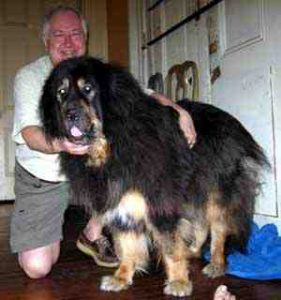
Essay Author, Bob Amato in New Orleans in 2012 visiting his best and only friend, ‘Wanna Be’ Bandleader, “Square Bear” – a 165 lb. Female Tibetan Mastiff that was 5 years old.