
Miriam Whaples UMASS Music History
Miriam Whaples UMASS-Amherst Music Department Music History 1966 – 2010

Dr, Miriam K. Whaples at the age of 6 months old in 1929.
Miriam K. Whaples (1929-2016) was awarded a B.A. 1950; M.M., 1954; and Ph.D., 1958 all from the University of Indiana.
Miriam Karpilow Whaples 1958 Doctoral Dissertations in Musicology was a 415 page ‘tomb’ entitled “Exoticism in Dramatic Music, 1600-1800″
In a nutshell, the irrepressible, Miriam’s 1958 415 Page dissertation focused on a comparison of original, authentic music and its European reproduction compared to original Turkish music which Ms. Whaples as ‘exotic’ music. Ms. Whaples also takes a stab at distinguishing ‘authentic’ Turkish music from ‘pseudo’ Turkish music.
The difference between ‘authentic’ Turkish music from ‘pseudo’ Turkish music must have 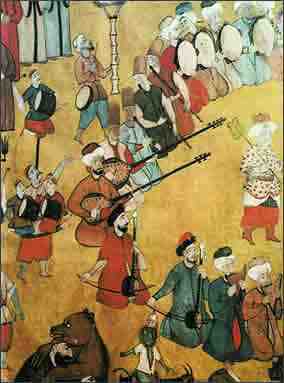 plagued the deep intellectual capabilities of Dr. Whaples. Forty years after the publication of the 1958 dissertation entitled “Exoticism in Dramatic Music, 1600-1800”, Dr. Whaples wrote an article in 1998 entitled “Early Exoticism Revisited”. (Reproduced in Bellman, The Exotic in Western Music, P. 19–21) In this Article, Dr. Whaples pointed out, with regard to the “Turkish Opera” (Turkenoper), that “in the musical depiction of exotic characters dn situations, seventeenth-and eighteenth-century composers almost entirely ignored what was known in Europe about authentic non-European music”. GOOD GRIEF! CAN YOU IMAGINE HOW PROFOUND THIS UPDATED REVELATION SHE SHARED TO THE WORLD WIDE MUSICOLOGICAL COMMUNITY MUST HAVE BEEN?
Dr. Whaples also authored Bach aria index, (MLA index series) in 1971.
Dr. Miriam K Whaples was unfortunately a member of the UMASS-Amherst Music Department Faculty form 1966 – 2010 where she primarily taught Music History and Ear Training through at least the 1967-1972 time frame when this Author was a UMASS-Amherst undergraduate music major.
The Author of this essay, was an instrumental performance major as well as an
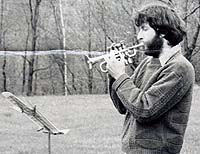
Essay Author, Bob Amato UMASS-Amherst 1967-1972 practicing Selmer 4 piston valve piccolo trumpet outdoors in the fall of 1970.
instrumental music education major at UMASS-Amherst from 1967-1972. As an instrumental music education major as well as a trumpet performance major, multiple semesters of music history courses were required. At least one semester of ear training was also a required course.
Sadly, Dr. Miriam Whaples was the only UMASS-Amherst Music Faculty member that taught music history and ear training to music majors. With all due respect, Dr. Miriam Whaples was as plain as a powdered donut without the powder.
Dr. Miriam Whaples Lack of Teaching Skills
In the late 1960’s this Author recalls taking at least one and probably two required music courses taught by Dr. Whaples. Although Dr. Whaples possessed an encyclopedic knowledge with regards to Western art music, the music history classes she taught were incredibly tedious. Dr. Whaples delivery of subject matter that is arcane was so dry and boring it became humorous to listen to her drone on and on and on in a relentlessly nasal monotone voice that had no modulation whatsoever.
Dr. Whaples particularly favored orchestral and chamber music from the late Classical and Romantic era. The musical compositions of Johannes Brahms and Franz Schubert
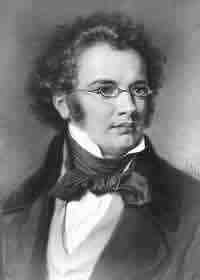
Franz Peter Schubert (1797-1828)
were Dr. Whaples two favorite composers. And, of these two, Schubert was her favorite.
However, the good thing was that it provided the Author of this essay lots of time to catch up on his sleep. Fortunately, this Author had a genuine interest in Music History and read the assigned course text book from cover to cover and did not bother to take any class written notes do to Dr. Whaples always causing this Author to fall sound asleep in the back of each and every one of the classes Dr. Whaples taught. One of the music history courses that Dr. Whaples taught had to do with identifying the name of both a composition and the composer of a classical music orchestral selection after hearing a short ‘snippet’ of a sound recording of the composition. Dr. Whaples provided the class with a ‘music listening’ list which was actually a quality list for listening purposes. However, the bad thing was the quality of the recordings and playback hardware at the UMASS-Amherst music library. In the late 1960’s, the UMASS-Amherst music library sound recording playback hardware must have been purchased back in the late 1940’s. The quality of the headphones, turntables, and amplifiers was abysmal. And, the quality of the LP vinyl records was even worse than the playback hardware. The vinyl recordings were all badly scratched and skipped terribly. Fortunately for this Author, this Author has always had a good memory for recalling recorded music details. Dr. Whaples would periodically test students music recall abilities by playing in her classroom brief excerpts of orchestral performances that were part of the class assigned ‘music listening list’. This Author got an ‘A’ on all of these exams and received an overall grade in Professor Whaples music history courses of at least a ‘B’.
This Author cannot remember how many courses in Music History were required to earn either a Music Performance and/or a Music Education Bachelor’s degree at UMASS-Amherst between 1967-1972. However, because this Author could not bare to suffer through anymore courses taught by Dr. Miriam Whaples, this Author took a Music History course over at Smith College in North Hampton, Massachusetts. UMASS-Amherst was part of a five college for credit system that enabled students who were enrolled at either UMASS-Amherst, Amherst College, Hampshire College, Mt. Holyoke College, and Smith College to take courses and earn class hour credits that would be applied to degree graduation requirements.
Smith College Had A Music History
Instructor Worse Than Dr. Miriam Whaples
Appallingly, the male character who taught the Music History Course at Smith College that
Model impersonating a surprising likeness of the Smith College music history instructor who possessed a PHD whose Music History course this Author suffered through back in the day when even then, men were not always men.
this Author enrolled in was even more abominably tedious than Dr. Miriam K. Whaples. Not only did this Smith College music history instructor have teaching skills that were worse than Dr. Miriam Whaples, he was a complete physical mess who wore coke bottle thick horned rimmed glasses, wore the same goofy looking bow tie to each class, wore ill fitting clothes, and spoke with a very distracting speech impediment. This Author recalls getting a ‘C’ in this course due to skipping so many classes because of the repulsive nature of the instructor.
This Author has often wondered if people with limited musical performance skills who get PHD’s in Music History ended up becoming inherently very ‘weird’ and inferior instructors at the advanced institution of higher learning where they are employed.
This supposition is reinforced by a comment that Dr. Miriam Whaples herself made at the bottom of Page 14 and the top of Page 15 in this published article entitled Shostakovich and the Soviet State authored by Jonah Katz – University of Massachusetts Amherst (May 12, 2003 – Edited January 2006):
“Dr. Whaples shared some memories of a 1998 American Musicological Society meeting in Boston that, according to her, “remains seared on the memory of all who attended” (Bottom of P. 14 to top of P. 15) Dr. Whaples remembered the meeting as a less-than-civil gathering, with panelists shouting at each other down and one audience member standing up to read in its entirety a polemic she’s written on the topic”
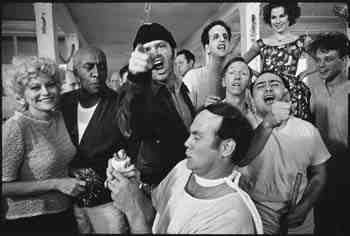
Scene from the 1975 film, One Flew Over The Cuckoo’s Nest.
And, think about this? What is the state of mind of a Music Department Head would feel that people with PHD’s in Music History who should be locked away in a ‘nut hatch’ for the terminally insane would hire people who are clearly social misfits. Dr. Whaples and ‘Mr. High Weirdness’ at Smith College would probably been best suited to be Librarians. How do two Music History Instructors with PHD’s with horrific teaching skills ended as teachers? Guess what? This Author knows the answer to his own question. Heads of Music Departments who hire social misfits with poor communication skills are probably social misfits with poor communication skills themselves.
This Author recalls that music majors at UMASS-Amherst were only provided with a single semester of ‘Ear Training’ between 1967-1972. This ‘Introduction to Ear Training’ course was taught by Dr. Whaples. This Author still has a copy of the book that Dr. Whaples used for this course. By way of hindsight, this ‘Introduction to Ear Training’ course was quite rudimentary in scope. In fact, this Author would have gotten an ‘A’ in this course at the age of 12 when this Author was in the 7th grade. The UMASS-Amherst Music Department would have been well served back in 1967-1972 if the school offered more advanced ‘Ear Training’ courses to music majors.
Between 1967 and 1972, this Author has no recollection whatsoever of Dr. Whaples
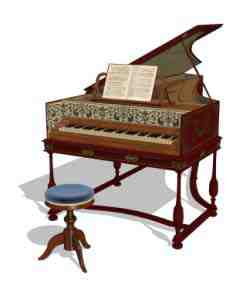
A Flemish harpsichord in the style of the Ruckers family – 3D render.
attending a single Music Faculty recital or student recital, or student ensemble performance of any kind at UMASS-Amherst as an audience member. However, it is likely that on at least one single occasion, Dr. Whaples grudgingly performed as a harpsichord accompanist on at least one Music Faculty recital performance.
For some interesting insights from 22 former students of Dr. Miriam Whaples, see Rate My Professors.
Out of a maximum score of 5, the irrepressible Dr. Miriam Whaples generated a deplorable 2.3 OVERALL QUALITY RATING!
(It is probable to this Author, that students who thought Dr. Whaples was a descent teacher were either as dysfunctional as she was or these students never experienced a high quality music instructor in their entire lives.)
Read these student insights:
MUSIC301: 06/13/2008:
“Whaples old age is definitely showing. You’ll hand in a paper at the beginning of class and she’ll hand it back at the end thinking she forgot to give it to you at the start of class. Music history is HARD though and not helpful.”
MUS350: 06/03/2008:
“I got a B in the class and did not learn a thing except that the word medium existed. The class was a waste of students time. The time for this class is better used practicing. I wish the administration would get a teacher who can effectively teach this course and not spend (no joke) half the class each day

Actors impersonating two useless buffoons, Dr. Miriam Whaples and UMASS-Amherst Music Dept. Head, Dr. Philip Bezanson dancing the night away in lieu of attending student musical performances.
talking about logistics.”
THIS REVIEW IN PARTICULAR IS A HOOT!!!!-MUS301: 06/02/2008:
“Extremely unclear and unhelpful. Falls asleep during class. Suffers from severe flatulence. This sounds like a joke, but she actually passes out and farts during class, particularly while students are taking exams. She has been at UMass since, oh, about 1934.”
MUS301: 12/13/2002:
“Someday soon, she’s going to drop dead, I swear!!!”
The Author of this essay has often wondered if a big night out for the sake of entertainment for Dr. Miriam Whaples would be to accompany the NEVER INSPIRATIONAL, Dr. Philip Bezanson as a dance partner at the local
Arthur Murray Ballroom Dance studio.
If personal attendance to support the performance of live classical music at UMASS-Amherst was a requisite to drawing paychecks for 44 years, Dr. Miriam K. Whaples was a disgrace to her chosen profession.
For someone who is reading this critique of two no talent College level Music History instructors with PHD’s who taught at ‘big name’ colleges, this Author has actually developed a substantial knowledge regarding Western Art Music History. As an example, by the summer of 1974, this Author had memorized the primary 1st trumpet parts of almost 200 chamber music as well as large orchestra compositions from the Baroque period well into the 20th Century.
This Author simply wishes to convey to a budding music major at the College level to beware of Music History instructors with PHD’s who have little or no skill performing as musicians in particular. A large percentage of Music History Professor’s who have earned PHD’s musical background is researching and listening to recorded music. These people are researchers only and are perfectly happy locking themselves in a closet and researching and writing about musical history minutia in great detail.
Using Miriam Whaples as an example, Dr. Whaples composed an arcane 415 page dissertation in 1958 that completed her PHD requirements at the University of Indiana. Between 1959 and 2010 when Dr. Whaples retired from the UMASS-Amherst Music Department, 51 years had passed. It is unlikely that Dr. Whaples published any books or articles taht even exceeded a grand total of 100 pages. Her ‘big deal’ article “Early Exoticism Revisited” referenced above was only 3 pages long.
Virtually all institutions of higher learning who employ a faculty member into the music department expect that faculty member to actively engage in musical performance and/or publish something meaningful. Can that be said of Miriam Whaples?
The first role of an instructor at an institution of higher learning is to teach and complete research and publish and/or perform as a secondary requirement. Miriam Whaples teaching skills were abominable to the point she never even learned to speak in a manner that was remotely pleasant to listen to. And, what did Dr. Whaples publish since 1959 of any consequence whatsoever?
Interestingly, between 1967 and 1972, UMASS-Amherst actually employed two music faculty members that were radically better music history instructors than Miriam Whaples will ever be after 10,000 reincarnations as a music history instructor. These two UMASS-Amherst faculty members are Professor Ronald Steele and Dr. Charles David “Chick” Lehrer”.
During the 1970’s, at the request of former student, and this Author’s old friend and classmate, Tom Parker, Professor Ronald Steele turned his popular introductory music course for non-music majors into a nationally-syndicated radio show, The Listening Room, which won FM radio’s highest prize, the Edwin Howard Armstrong Award.
Dr. Charles David “Chick” Lehrer was a brilliant musicologist who specialized in music of the Baroque Era in particular. Dr. Lehrer was also a magnificent oboe virtuoso. Although Dr. Lehrer did not teach Music History at UMASS-Amherst, he did do so when he joined the music faculty of California State University at Northridge. With complete certainty, Dr. Lehrer provided his music history students a richly rewarding and highly educational experience.
So what seperated Professor Steele and Dr. Lehrer from the likes of Dr. Miriam Whaples?
Although by no means a virtuoso on the violin of the caliber as a Julian Olevsky, in his younger years in particular, Professor Steele was a capable violinist. And, Professor Steele was an excellent conductor of the UMASS-Symphony Orchestra for decades.
Dr. Lehrer was a top drawer oboe soloist to the point where he performed a solo oboe recital in 1980 at Carnegie Hall.
Both of these music history instructors were active ‘public’ performers who knew how to communicate as well as entertain both students and listening audiences alike.
It is likely that the only body of people that either Dr. Miriam Whaples and her Smith College music history instructor counterpart could relate to were themselves only.
And, what about that character, the ‘esteemed’ Dr. Philip Bezanson, Dr. Whaples buffoonish dance partner?
Bezanson was the Head of the UMASS-Amherst Music Department between 1967-1972.
Talk about being challenged from a student communications point of view. This Author played 1st chair cornet and/or trumpet in the UMASS Concert Band, Symphony Band, Symphony Orchestra, performed numerous solo trumpet as well as brass ensemble recitals between 1967-1972. In five years, not once did Dr. Philip Bezanson utter once single word to this Author other than ‘grunt’ when this Author passed Bezanson while walking on campus.
Not only did Bezanson never speak to any music students, his supposed wonderful musical compositions were never performed on a single occasion between 1967-1972.
Any UMASS-Amherst music major that made his way in life as a musician sure did not do so do from any encouragement that either Dr. Whaples or Dr. Bezanson provided. The only musical enrichment that Dr. Whaples and Dr. Bezanson provided was TO THEMSELVES AT MASSACHUSETTS TAXPAYER EXPENSE FOR RADICALLY LONGER THAN EITHER DESERVED!

Bob Amato in New Orleans in 2012 visiting his best and only friend, ‘Wanna Be’ Bandleader, “Square Bear” – a 165 lb. Female Tibetian Mastiff that is 5 years old.